Understanding Solar Photovoltaic Systems
Clean energy is changing homes and industries today. The Solar Photovoltaic System is key to this change. Many people call it a “solar power system.”
This technology captures free energy from the sun. It turns that light directly into usable electricity. If you want to save on bills or become energy independent, learning about a Solar Photovoltaic System is your starting point.
The word “Photovoltaic” means converting light (“Photo”) directly into electric power (“Voltaic”). It is a powerful idea that is making solar one of the fastest-growing energy sources in the world.
How Does a Solar Photovoltaic System Work?
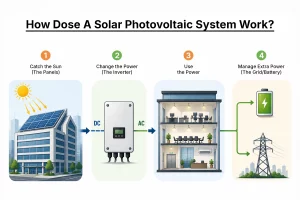
A Solar Photovoltaic System uses several parts that work together smoothly. They turn sunlight into the power you need to run your fan or lights.
From Sunlight to Usable Electricity
The process has four clear steps:
- Catch the Sun (The Panels): It starts with the solar panels. These panels have cells that catch sunlight. This energy excites tiny particles (electrons) inside the cells, which creates a direct current (DC) of electricity.
- Change the Power (The Inverter): The DC power from the panels is not right for most industries. Most industries use alternating current (AC) power. This is where the inverter works. Its job is to efficiently change the raw DC power into usable AC power.
- Use the Power: The usable AC power travels through safety boxes and wires to your main electrical panel. From there, it powers your lights and appliances.
- Manage Extra Power (The Grid/Battery): If you make more electricity than you use, the extra power is managed. It is either stored in batteries for later use or sent back to the main power grid. Sending it back can earn you credit (called net metering).
Types of Solar Photovoltaic Systems
Solar systems are built differently based on where you live and what you need. The three main types of PV panel systems are:
1. On-Grid Photovoltaic Systems
This is the most common system. It stays connected to the public electricity grid.
- How it Works: Your system uses the grid like a large backup. If you produce extra power, it goes to the grid. When your panels are not producing (like at night), you draw power from the grid.
- Best For: City and town areas with a reliable grid connection. It gives the best financial return by letting you offset your electricity usage.
- Key Advantage: Batteries are not required, which makes the system simpler and costs less.
2. Off-Grid Photovoltaic Systems
This system is totally separate from the public electricity grid.
- How it Works: All the electricity made by the panels is stored in special batteries. This stored energy is used at night or on cloudy days. You must have enough batteries to cover all your energy needs.
- Best For: Remote or rural locations where getting a grid connection is too hard or too costly.
- Key Component: Batteries are a must-have. This gives you complete energy independence.
3. Hybrid Photovoltaic Systems
A hybrid solar system connects to the grid but also includes battery storage.
- How it Works: It mainly uses solar and the grid. Batteries are kept as backup. If the grid fails (a power cut), the system switches to the stored battery power automatically. This ensures you have light and power without interruption.
- Best For: Homes and businesses in areas with frequent power cuts that still want the financial benefit of net metering.
Installation of Photovoltaic Systems
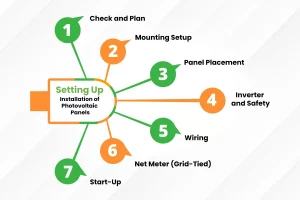
Installation of photovoltaic systems is a skilled job. It must be done right to ensure safety and maximum energy output over many years.
Step-by-Step Installation of Photovoltaic Systems
- Check and Plan: An expert team first visits your property. They check the roof, space, and how much sun you get. This helps decide the right system size and the best angle for the panels.
- Mounting Setup: Metal structures are securely fixed to the roof or ground. These strong structures hold the panels. They are designed to withstand heavy rain and strong winds.
- Panel Placement: The photovoltaic panels are lifted and fastened onto the structure. They are wired together in a specific way to get the correct voltage.
- Inverter and Safety: The solar inverter is installed in a cool, safe place. Safety circuit boxes and a grounding system are set up to protect the whole system from power surges.
- Wiring: DC wires run from the panels to the inverter. AC wires run from the inverter to your main electrical panel.
- Net Meter (Grid-Tied): The utility company installs a special meter (net meter) to track the power you use and the extra power you send back.
- Start-Up: The system is tested, switched on, and certified. Once this is complete, you begin making your own clean power!
Types of PV Panels and Technology
The solar panels are the most critical part. In 2026, solar technology is better than ever. When you look at the types of PV panels, you will mainly see these:
1. Monocrystalline Solar Panels (The Highest Performer)
- How They are Made: Monocrystalline Solar Panels are made from a single, pure piece of silicon crystal. They have a uniform, sleek black look.
- Pros: They have the highest efficiency rates (often over 22%). They need less roof space to make the same amount of power. They work well even when the light is low.
- Cons: They usually cost the most upfront.
- Latest Technology: The photovoltaic panels today use advanced designs like N-Type cells. These cells push efficiency even higher.
2. Polycrystalline Solar Panels (The Affordable Choice)
- How They are Made: Polycrystalline Solar Panels are made from melting several silicon pieces together. They have a blue, speckled look.
- Pros: They are more budget-friendly than Monocrystalline panels.
- Cons: They have slightly lower efficiency (around 15% to 17%). They need more space to generate the required energy.
- Industry Note: Because the cost of the more efficient Monocrystalline type has dropped, Polycrystalline panels are used much less today.
3. Thin-Film Solar Panels (The Flexible Option)
- How They are Made: Thin-Film Solar Panels are made by putting a very thin layer of solar material onto a base. They are light and often flexible.
- Pros: They are the lightest and most flexible type. They are good for unique uses like curved roofs.
- Cons: They have the lowest efficiency. They require the most space to generate power, so they are rarely used for standard home roofs.
People Also Read: Difference Between Smart Grid and Microgrid
Advantages and Disadvantages of A Solar Photovoltaic System
Moving forward, Solar Photovoltaic Systems offer major benefits. Know the full picture before you invest.
Advantages of Solar Photovoltaic Systems

- Huge Savings: Making your own electricity means buying less from the power company. This leads to massive savings, often 80% or more.
- Good for the Planet: Solar power is clean. It produces zero pollution while running, helping fight climate change.
- Energy Safety: You depend less on the public grid. You are also protected from rising electricity costs.
- Easy Upkeep: Once installed, Solar Photovoltaic Systems need very little maintenance. Usually, a simple cleaning a few times a year is all that is necessary.
- Long Life: Modern solar panels are built to last. They come with warranties of 25 to 30 years, giving you decades of reliable power.
- Government Help: Schemes like the PM Surya Ghar Yojana offer subsidies. These programs make the initial cost of installation of photovoltaic panels much more manageable for everyone.
Disadvantages of Solar Photovoltaic Systems
- Initial Investment: The starting cost for a good Solar Photovoltaic System can be high. However, the long-term savings often lead to the system paying for itself quickly (as fast as 3 to 5 years for businesses).
- Needs Space: You must have enough clear space on your roof or land for the panels to make the electricity you need.
- Sunlight Needed: Solar panels only make power when the sun is out. Production drops on cloudy days and stops at night. This requires battery storage (for off-grid use) or a connection to the public grid.
India’s Green Leap: The Industry in 2026
The year 2026 is a time of huge, fast growth for solar in India. The commitment to Solar Photovoltaic Systems is stronger than ever.
Key Industry Trends in 2026
- Big Capacity Growth: India’s solar capacity has jumped sharply. It is now well over 164.59 GW (Source: Government data). Solar power makes up more than 50% of the country’s total clean energy capacity.
- Home Revolution: Government programs like the PM Surya Ghar Yojana have greatly increased the installation of pv panels on home rooftops. Nearly 24 lakh households have adopted rooftop solar by the end of 2026.
- Technology Shift: The market for photovoltaic panels is quickly moving to high-performance cells. Modern panel efficiency now regularly passes 24%. This means you need less space to make more power.
- Local Production: Government incentives are pushing Indian manufacturers to make more and better technology. This strengthens the entire solar sector in India.
Your Partner in Solar: Why Choose Novergy
Deciding to go solar is a big choice. Choosing the right partner for the photovoltaic panels installation is just as important. Novergy provides high-quality, reliable, and custom-made Solar Photovoltaic Systems. We serve homes, businesses, and industrial sites across India.
How Novergy Ensures the Best Photovoltaic Panels for You
- Custom Design: We do not use a single plan for everyone. Our experts check your site and design a system perfectly matched to your energy use and sun profile.
- High-Efficiency Technology: Novergy focuses on the best photovoltaic panels. We use the latest high-performance cell technologies. This ensures you get the most power from your space and the fastest return on your investment.
- Full-Service Support: From the first meeting and getting permits to the final start-up and long-term care, Novergy manages the entire photovoltaic panel installation process easily.
- Financial Expertise: We help you navigate the various government subsidies and financing options available in 2026. This makes your change to solar smooth and affordable.
Quick Summary: Your Solar Checklist
| Part/Feature | Job in a Solar Photovoltaic System | Main Benefit for You |
| Photovoltaic Panels | Change sunlight into raw electricity. | Make clean, free power. |
| Inverter | Changes raw DC power into usable AC power. | Makes the electricity safe for home/business use. |
| Monocrystalline Panels | Single-crystal cell structure. | Highest efficiency, needs less space. |
| Installation of Photovoltaic Panels | The expert setup process. | Ensures maximum energy generation and safety. |
| Net Metering | Tracks extra power sent to the grid. | Cuts down or eliminates monthly electricity bills. |
| N-Type Cells | Advanced cell technology. | Represents the best photovoltaic panels of 2026. |
Conclusion to Solar Photovoltaic Systems
The Solar Photovoltaic System is vital to India’s energy future. It offers a clear path to savings, clean energy, and power independence. With the cost of the installation of photovoltaic panels being lower and the efficiency of the best photovoltaic panels rising, there has never been a better time to switch.
Your journey to clean power begins with a quick call with Novergy. Let us guide you toward installing a high-performance Solar Photovoltaic System that will power your life for decades to come.
FAQs: Solar Photovoltaic Systems
Q1: What is a solar PV system?
Ans: A solar PV system is a renewable energy setup that converts sunlight directly into electricity.
Q2: What is the main job of a Solar Photovoltaic System?
Ans: The main job of a Solar Photovoltaic System is to convert light (Photo) directly into electrical power (Voltaic), using solar panels, and then changing that power into usable electricity for homes and businesses.
Q3: What are the main types of PV panels available in 2026?
Ans: The main types of PV panels are Monocrystalline (highest efficiency, best for limited space) and Thin-Film (flexible, lowest efficiency). Monocrystalline panels, especially those using advanced N-Type cells, are considered the best photovoltaic panels for most modern installations.
Q4: How long does the installation of photovoltaic panels usually take?
Ans: The physical installation of photovoltaic panels for a standard home or small system typically takes only 1 to 3 days. However, the full process, including site checks, permits, and final testing, can take several weeks depending on local approval times.
Q5: Is a Solar Photovoltaic System worth the money in 2026?
Ans: Yes, absolutely. Costs for technology have dropped, efficiency has increased, and government subsidies are widely available. This means the system pays for itself quickly—often between 3 to 5 years for businesses and under 6 years for homes in India.
Get product details