Introduction to Types of Solar Panels
Switching to solar is no longer just a “green” choice for Indian businesses. It has become a vital financial strategy. As of February 2026, India’s solar capacity has reached 143.6 GW, proving that thousands of companies are already cutting costs. With industrial electricity demand projected to grow by 6.6% this year, the sun offers a reliable way to freeze your power bills.
But as a manager, you aren’t just looking for any setup. You want the one that pays for itself the fastest. Choosing the best solar panels for your factory can be the difference between a project that just “works” and one that saves you crores of rupees.
Understanding the Different Types of Solar Panels
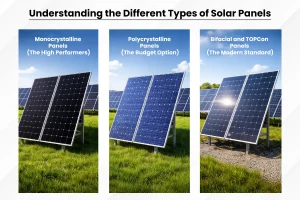
Before we talk about money, we need to know what we are buying. Not all technology is the same. In the 2026 market, you will mostly see three main types of solar panels:
1. Monocrystalline Panels (The High Performers)
These consist of a single, pure silicon crystal. You can spot them by their sleek black look. Because the silicon is high quality, they are efficient and work well when your roof space is tight.
2. Polycrystalline Panels (The Budget Option)
These use many silicon crystals melted together. They have a blue, speckled appearance. While they are cheaper at first, they are less efficient and need more space to produce the same power.
3. Bifacial and TOPCon Panels (The Modern Standard)
Bifacial modules are often the best solar panels for industries with flat roofs or open land. They catch sunlight from both the front and the back. New Bifacial solar modules can boost your energy yield by 8% to 30% compared to standard ones.
People Also Read: Monocrystalline vs Polycrystalline Solar Panels: Which is Better for Industries?
Why ROI is the Only Metric That Matters
In business, we don’t just look at the price tag. We look at the return. Calculating the ROI on solar panels involves comparing what you spend today against what you save on monthly bills over 25 years.
For a factory, “cheap” panels often lead to a poor return. They degrade faster in the heat and produce less power during peak hours. To get the best solar panels for ROI, you must look at efficiency and how long they last. Investing in industrial solar benefits your bottom line by reducing “peak demand charges” from the grid.
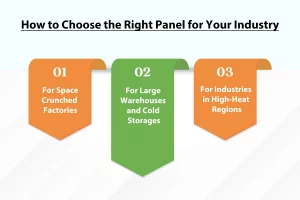
How to Choose the Right Panel for Your Industry
Different industries have different needs. Use this guide to help you decide.
1. For Space-Crunched Factories
If you have a small roof but high bills, high-efficiency Monocrystalline panels are your best bet. They pack more power into every square inch. This ensures you get a high ROI on solar panels even with limited real estate.
2. For Large Warehouses and Cold Storages
If you have a massive, flat roof, Bifacial panels are excellent. They use light reflecting off the roof surface to generate extra power. This is vital for businesses that run cooling systems all day and night. Using utility-scale solar projects as a reference shows that Bifacial tech offers the lowest cost per unit of electricity.
3. For Industries in High-Heat Regions
Standard panels lose power when they get too hot. In states like Rajasthan or Gujarat, where temperatures hit 45°C, you need panels with a low “temperature coefficient.” Advanced Twin-cell solar technology helps the system stay cool and keeps your power production high.
Why Quality Leads to Better Savings
It is tempting to choose the lowest quote. However, the best solar panels for ROI are those that stay at peak performance for decades.
At Novergy, we focus on designs that handle “shading” issues. If one part of the panel is in the shade, the rest keeps working. This reliability is what secures your financial future. Proper solar maintenance best practices also ensure your high-tech panels don’t lose efficiency due to dust or grime.
Checklist for Industrial Solar Selection
- [ ] Measure your space: Limited space needs higher efficiency.
- [ ] Check the temperature: Ensure the panels handle 40°C+ heat.
- [ ] Review the warranty: Look for at least a 25-year performance guarantee.
- [ ] Analyze the surface: Reflective roofs get more out of Bifacial tech.
- [ ] Verify the developer: Use experts for solar project management to avoid installation errors.
Making the Final Call for Your Factory
Selecting the best solar panels for your industry is a one-time decision. It stays with you for a quarter of a century. Make sure it is a choice that keeps your balance sheet healthy. To see which types of solar panels fit your specific roof and budget, we invite you to explore Novergy’s Range of Solar Panels and start saving on your energy costs today.
Frequently Asked Questions
1. How long does it take to get a full ROI on solar panels?
Ans: For most Indian industries, the payback period is between 3 to 5 years. After that, the electricity is essentially free for the next 20 years.
2. Are Bifacial panels the best solar panels for every roof?
Ans: They work best on flat, light-colored roofs or ground-mounted systems. On a dark, sloped metal roof, the “rear side” gain might be lower.
3. Do different types of solar panels require different maintenance?
Ans: Generally, no. However, Bifacial panels need the space underneath them to stay clear and reflective to maximize the extra power gain.
Get product details