Introduction: Solar Genset Hybrid System
A solar genset hybrid system is a setup where solar panels, a battery bank, and a diesel or gas generator all work together, with a controller deciding which one should supply power at any given moment. The outcome is simple: the generator runs far less, fuel bills go down, and you still have reliable power when the sun isn’t shining.
That’s the quick version. Below is how it actually works, what kind of savings you can realistically expect, and what to check before putting money into one.
What Exactly Is a Solar Genset Hybrid System?
Picture three components that don’t naturally get along, forced to work as a team.
Solar panels are cheap to run but useless at night or on a cloudy day. A diesel or gas generator will run whenever you need it, but fuel and upkeep add up fast. A battery can store energy, but it needs a source to fill it up in the first place. A solar genset hybrid system connects all three through a controller that keeps track of how much power is being used, how full the battery is, and how much the sun is putting out, then sends power from whichever source makes sense right then.
This is not the same as a regular grid-connected solar system, which has no generator to fall back on, and it’s not the same as running a generator on its own, which burns fuel non-stop no matter how light the load is. This kind of setup is built for places that need power around the clock but can’t afford to keep a generator running all day: factories, warehouses, construction sites, telecom towers, hospitals, and commercial sites with patchy grid supply.
How It Actually Works
The Parts Involved
- Solar panels – produce electricity during daylight, usually covering somewhere between 30% and 70% of daytime power needs depending on system size and how much sun the site gets
- Battery bank – lithium-ion or lead-acid batteries that store extra solar power for use after sunset or when it’s cloudy
- Generator – kicks in automatically as backup when solar and battery power aren’t enough to cover the load.
- Controller – the part that manages all three sources, converts the power to a usable form, and keeps the generator from running at a low, wasteful load
What Happens Through the Day
During daylight, solar power goes straight to whatever is running on site. Any extra goes into the battery instead of being wasted. Once the sun goes down or demand goes up more than solar and the battery can handle, the controller starts the generator, but only enough to make up the difference, not to carry the whole load. At night, the battery covers the baseline power needs, and the generator stays off unless the battery runs low. Because the generator is now running at a steadier, more efficient load instead of switching on and off constantly, it uses less fuel for every unit of power it makes, and it wears out more slowly too.
That’s actually where most of the fuel savings come from, not just the fact that the generator runs fewer hours, but that it’s no longer running half-loaded and inefficient when it does.
What You Actually Gain From This
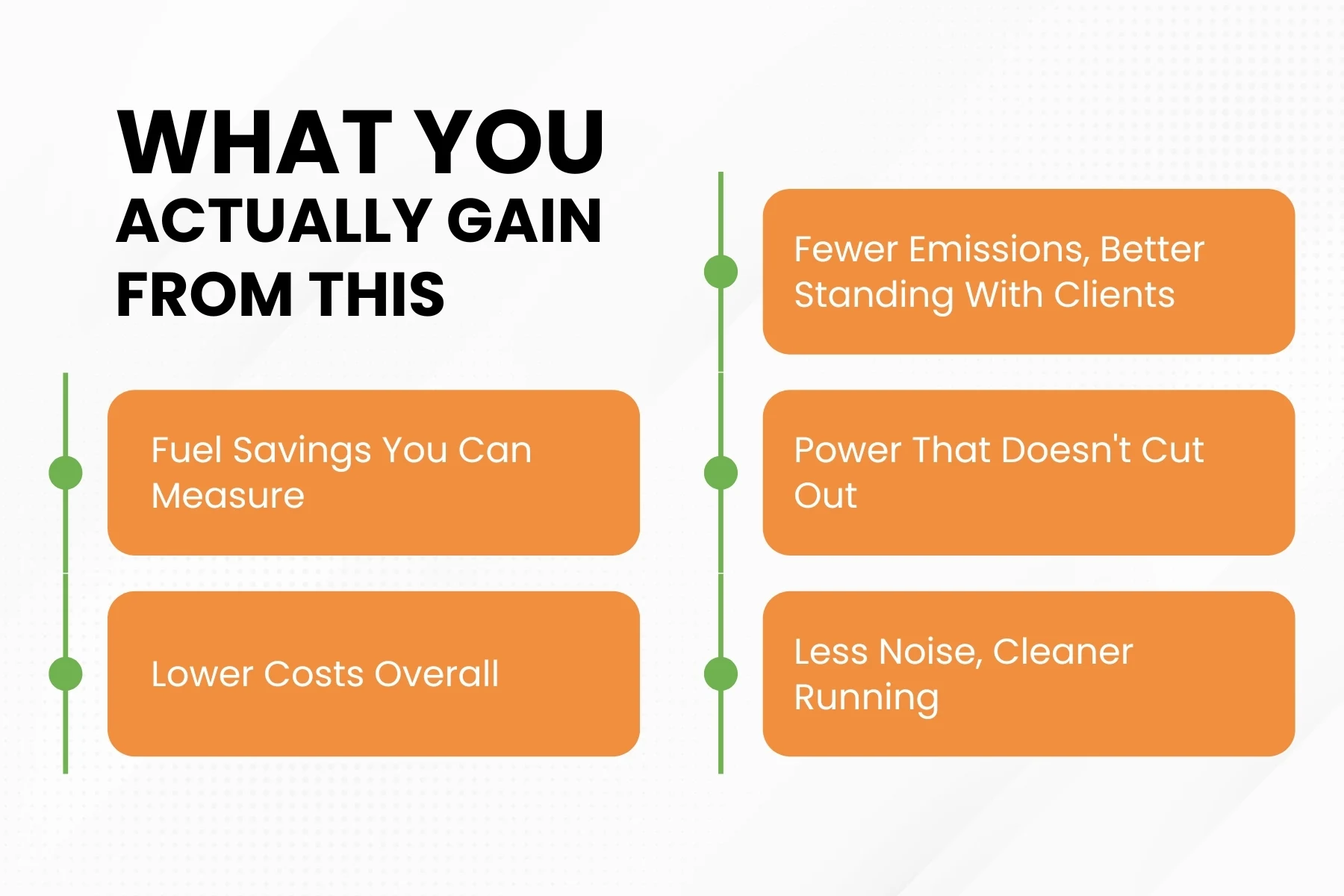
Fuel Savings You Can Measure
Real-world data on solar-diesel hybrid setups generally shows generator runtime dropping by 30% to 70%, with well-designed systems landing on the higher end. Take a mid-sized site running a generator 10 hours a day, burning 20-30 litres an hour; once solar and the battery take over most of the daytime and evening load, the litres saved over the life of the project add up to a big number.
Lower Costs Overall
- Running the generator less means fewer service visits and a longer engine life.
- Less fuel to buy, transport, and store on site
- Lower peak-demand charges in places where the utility bills are based on how much power you draw at once
Fewer Emissions, Better Standing With Clients
Every litre of diesel you don’t burn is carbon you don’t put out, something that’s now showing up more in compliance checks, tender scoring, and sustainability reviews, particularly for government and industrial contracts.
Power That Doesn’t Cut Out
Solar on its own can’t promise power 24 hours a day, and running a generator non-stop is expensive. Put together, they cover each other’s weak points, which matters most for places that can’t afford outages, cold storage units, server rooms, hospitals, and production lines with equipment that’s sensitive to power cuts.
Less Noise, Cleaner Running
Since the battery handles the baseline load, the generator can stay off for long stretches at a time, helpful for sites near residential areas or working under noise restrictions.
Where These Systems Get Used
- Commercial and industrial sites with high daytime power use and patchy or unreliable grid connections
- Construction and mining sites where a grid connection isn’t an option and hauling diesel is costly.
- Telecom towers and remote sites that need steady power without much maintenance
- Hospitals and other critical facilities where power simply cannot go out
- Data centres and server rooms looking to add renewable power without giving up backup reliability
If you’re looking into a hybrid setup for a commercial or industrial site, it’s worth going through our solar EPC project portfolio to see how similar systems have been sized and built for industrial loads.
Things to Check Before You Install One
- Start with your actual load, not a guess. Putting in more solar than your daytime demand needs wastes money, and a battery that’s too small won’t cut generator hours the way you’re expecting.
- Think about the battery type. Lithium-ion costs more to buy but usually lasts several thousand more charge cycles than lead-acid — this matters a lot when you’re looking at costs over 10 years or more.
- Make sure the controller works with your generator. Not every hybrid controller plays well with every generator model, so this needs to be confirmed before you buy anything, not after.
- Use real solar data for your location. How much power you’ll actually generate depends on your site’s sun exposure, not just the numbers printed on the panel.
- Check local rules and incentives. Net metering policies, subsidies, and grid connection rules differ from state to state and can change how quickly the system pays for itself.
Conclusion: Solar Genset Hybrid System
A solar genset hybrid system offers a practical way for commercial and industrial sites to reduce their dependence on diesel while maintaining reliable power. By combining solar, battery storage, and a generator through an intelligent controller, businesses can reduce fuel consumption, lower operating costs, extend generator life, and maintain power availability when solar generation is not enough.
However, the performance and savings of a hybrid system depend heavily on proper system sizing, load analysis, battery selection, and generator integration. A solution designed around your site’s actual energy requirements can deliver far better results than a standard, one-size-fits-all setup.
If you’re considering a solar genset hybrid system for your industrial or commercial facility, Novergy can help you evaluate your power requirements and design a solution around your operational needs. Contact Novergy today to discuss your solar genset hybrid requirements and explore the right solution for your site.
FAQs: Solar Genset Hybrid System
1. What is a solar genset hybrid system, in plain terms?
Ans: It’s a power system where solar panels and a battery handle most of the electricity supply, and a diesel or gas generator only steps in as backup. This cuts fuel use while keeping the power reliable.
2. How much fuel can a hybrid system actually save?
Ans: Most well-built systems cut diesel use by 30% to 70%, depending on on-site power use, battery size, and how much sun the location gets.
3. Is this worth it for a smaller business?
Ans: Yes, if diesel is already a high, recurring cost. Smaller commercial sites with steady daytime power use often see the system pay for itself within 3 to 5 years.
4. Can I add this to a generator I already own?
Ans: In most cases, yes. You can usually add a controller and battery bank to an existing generator without replacing it, as long as you check compatibility beforehand.
5. Does this work without a battery?
Ans: It can, technically, but without a battery, the generator still has to run every time the sun isn’t out, which cuts down a lot of the fuel savings you’d otherwise get.
Get product details