

Introduction to SmartGrid & MicroGrid
Have you ever noticed how our phones went from being simple calling devices to “smart” gadgets that handle everything? The same thing is now happening to our electricity. For years, we relied on a simple power grid that sent electricity in one direction, from a big power plant to your home.
Today, that is changing. We are moving toward more intelligent and flexible ways of managing power. Two words you will often hear in this new energy world are SmartGrid and MicroGrid. While they might sound similar, they play very different roles in keeping our lights on.
What is SmartGrid?
To understand the bigger picture, let’s start with the basics. What is SmartGrid? Think of it as the “Internet of Electricity.”
In a traditional grid, if a tree falls on a wire, the power company might not know until someone calls to complain. A SmartGrid uses digital technology, sensors, and two-way communication to monitor everything in real-time. It can “talk” to your appliances and the power station at the same time.
Because it is “smart,” this grid can automatically fix faults, reroute power during an emergency, and better handle renewable energy like solar and wind. It makes the entire country’s power system more efficient and less prone to big blackouts.
What is MicroGrid?
While a SmartGrid covers a huge area (like a whole state or country), a MicroGrid is much more local.
So, what is MicroGrid? Imagine a small, self-contained power system designed specifically for a single village, a large hospital, a college campus, or an industrial factory. It has its own energy sources, usually solar panels combined with batteries or a backup generator.
The most special feature of a MicroGrid is its ability to “island.” This means if the main city power goes out, the MicroGrid can disconnect from the main grid and keep running on its own. It’s like having your own personal power plant that will continue to perform efficiently even if there is a power cut in the city.
Difference Between MicroGrid and SmartGrid
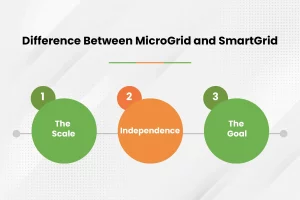
It is easy to get confused between MicroGrid and SmartGrid, but here is a simple way to look at the difference between MicroGrid and SmartGrid:
1. The Scale
- A SmartGrid is a big and wide network that connects everyone across a city or town. A MicroGrid is a small, focused system for a specific area.
2. Independence
- A SmartGrid is the main system. If it fails, everyone connected to it usually loses power. However, a MicroGrid can separate itself and work independently during a crisis.
3. The Goal
- The goal of a SmartGrid is to make the national power supply more intelligent and efficient. The goal of a MicroGrid is to provide local reliability and 24/7 power security.
In many cases, a MicroGrid is actually a small part of a larger SmartGrid. They work together to make sure energy is used wisely and never wasted.
People also read: Discover the Difference between Ground and Rooftop Solar
Different Types of MicroGrid Systems
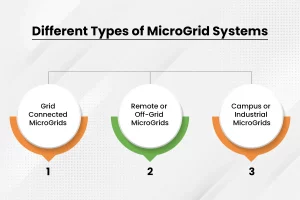
Not every MicroGrid is built the same way. Depending on where it is located, it might work differently:
1. Grid-Connected MicroGrids
- These On-grids are physically connected to the main utility grid. They usually take power from the city but switch to their own solar and battery power if the city grid fails or if electricity prices become too high during the day.
2. Remote or Off-Grid MicroGrids
- These are found in regions where the main power lines don’t reach, like deep rural villages or remote islands. These systems are 100% independent and rely entirely on local sources like solar energy and large battery banks.
3. Campus or Industrial MicroGrids
- Large factories or hospitals use these to ensure their sensitive equipment never stops. Even a one-minute power cut can cause huge losses for a factory, so they use a dedicated MicroGrid to stay safe.
Advantages of MicroGrid and SmartGrid
Whether we are talking about a large-scale SmartGrid or a local MicroGrid, the benefits for people in India are huge:
- No More Blackouts: Because these systems can detect problems and switch to backup power instantly, you don’t have to worry about sudden power cuts.
- Saving Money: By utilising solar energy when it is brightest and saving it in batteries, you can avoid the high peak-time charges from your electricity provider.
- Helping the Planet: Both systems make it much easier to use “green” energy. Instead of burning coal, we can rely more on the sun and wind.
- Local Control: With a MicroGrid, a community or a business owner has more control over their own energy future.
Moving Toward a Brighter Future
As India grows, our need for reliable power grows too. Moving away from old, traditional grids and opting for the SmartGrid technology is the only way to build a modern country. At the same time, for factories, hospitals, and housing societies, installing a MicroGrid is the best way to ensure they never face a dark day again.
Understanding the difference between MicroGrid and SmartGrid helps you make better decisions for your home or business. The future of energy is local, smart, and green. If you still have any queries regarding Smartgrid and Microgrid, contact Novergy Solar to solve them.
FAQs: MicroGrid and SmartGrid
1. What is the difference between SmartGrid and MicroGrid?
Ans: The main difference between SmartGrid and MicroGrid is that MicroGrid is for small regions, and SmartGrid is for large areas.
2. What is the concept of MicroGrid?
Ans: MicroGrids are small grids that operate independently to generate electricity for a localised area.
3. What are the three types of MicroGrids?
Ans: Grid-connected MicroGrids, remote or off-grid MicroGrids, and industrial MicroGrids are the three types of MicroGrids.
4. What are the 5 components of a SmartGrid?
Ans: Advanced metering infrastructure(AMI, smart sensors & controls, communication networks, distributed energy resources (DERs), and energy storage systems are the main 5 components of a SmartGrid.
5. What is another name for a MicroGrid?
Ans: MiniGrid is another name for a MicroGrid.
6. What are the components of a MicroGrid?
Ans: Controllable loads, distributed energy resources, and solar panels are three components of a MicroGrid.