Introduction: Best Solar Park Developer Vs Local Developer
India is currently hitting record-breaking numbers in clean energy. By early 2026, the country’s solar capacity reached 160.59 GW, showing a massive 40-fold increase over the last decade. While putting a few panels on a roof is a great start, building a massive solar park is a different ball game.
When you decide to scale up, you face a big choice. Should you hire a local solar park developer or partner with the best solar park developer in the industry? A local player might seem easy to reach, but the long-term results vary wildly. Let’s break down the facts so you can protect your investment.
What Exactly is a Solar Park?
Think of a solar park as a giant, industrial-scale power station. Instead of burning coal, it uses thousands of panels to feed clean electricity into the main grid. These projects often cover hundreds of acres.
Because of the scale, you need a professional solar park developer to handle the heavy lifting. This includes buying land, getting state permissions, and building high-voltage power lines. According to recent reports, India has already sanctioned 55 solar parks across 13 states to meet its 2030 green energy goals.
Key Responsibilities of a Solar Developer
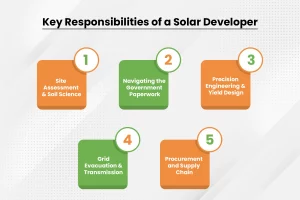
A developer does much more than just bolt panels to the ground. They act as the “brain” of the entire project. Whether you choose the best solar park developer or a local one, they must handle these technical stages:
1. Site Assessment and Soil Science
It is not enough to just find a flat field. A developer must check if the soil can hold heavy steel structures for 25 years. They also look at “Global Horizontal Irradiance” (GHI) to see how much sun actually hits the spot. This ensures your solar project management starts with a solid foundation.
2. Navigating the Government Paperwork
In India, setting up a power plant involves dozens of permits. This includes land conversion, environmental clearances, and grid connectivity approvals. An expert solar park developer knows how to handle these with state departments. They ensure you stay on the right side of the law as the 2026 solar park schemes continue to evolve.
3. Precision Engineering and Yield Design
The goal is to squeeze every drop of energy out of the sun. The developer designs the layout to avoid “shading” where one row of panels blocks the other. They plan for efficient utility-scale solar projects by choosing the right cables to minimize power loss during transmission.
4. Grid Evacuation and Transmission
Getting the electricity from the field to the public grid is often the hardest part. The developer builds the substations and high-voltage lines. If the grid is too far away, costs skyrocket. The best solar park developer will identify land that is close to a substation to save you millions in infrastructure costs.
5. Procurement and Supply Chain
They source the “Tier-1” components. This means getting the best panels, inverters, and trackers at the best price. Since modern or latest modules can boost power output by 15% to 30%, an expert developer ensures you aren’t stuck with old, low-efficiency technology.
People Also Read: Novergy’s 40 MW Plug and Play Solar Park in Maharashtra
Working With a Local Solar Park Developer
A local solar park developer usually operates within one state or city. They know the local landowners and the regional language. This can make the early stages feel very personal and simple.
- The Pros: They are nearby for meetings and understand local ground conditions.
- The Cons: They often lack the massive resources needed for “utility-scale” projects. A local team might struggle with the latest utility-scale solar projects or high-end engineering. They also might not have the financial backup to keep a 50MW project on schedule if issues arise.
Why the Best Solar Park Developer Wins on Scale
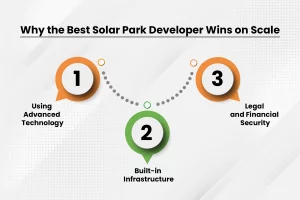
The best solar park developer doesn’t just “install panels.” They treat your park as a 25-year financial asset. Companies like Novergy fall into this category because they focus on “yield”—how much money each panel makes you over time.
1. Using Advanced Technology
The best solar park developer uses high-efficiency tech like Bi-facial panels. These panels catch sunlight on both sides. Experts note that bi-facial modules can boost power output by 15% to 30% compared to standard panels. A local solar park developer might stick to basic technology because it’s cheaper to source, but you lose money every single day the sun shines.
2. Built-in Infrastructure
Expert developers build roads, drainage, and water systems before the first panel arrives. They ensure the solar park infrastructure needs are met to prevent damage during monsoons. This “all-in-one” approach makes the park much more reliable over two decades.
3. Legal and Financial Security
Large projects require complex “Power Purchase Agreements” (PPAs). The best solar park developer has the legal experience to handle these contracts. They ensure your land acquisition for solar is ironclad, protecting you from future legal battles or government policy shifts.
People Also Read: Captive Solar Power Plants in Commercial Use
Comparing the Two: At a Glance
| Feature | Local Solar Park Developer | Best Solar Park Developer (Novergy) |
|---|---|---|
| Technology | Often basic or older models. | High-output Bi-facial or TOPCon. |
| Execution | Can be slow due to limited staff. | Fast, system-driven timelines. |
| Grid Knowledge | Focuses on local connections. | Expertise in grid integration in India. |
| Maintenance | Basic cleaning services. | AI-based monitoring and expert solar operation & maintenance. |
Checklist for Choosing Your Developer
Before you sign a contract, run through this quick checklist to see if your partner is up to the task:
- Does the team have a track record of 20MW+ projects?
- Do they offer industrial solar benefits like tax depreciation advice?
- Are they using Tier-1 components with 25-year warranties?
- Do they have a clear solar maintenance best practices plan?
- Can they handle the entire “EPC” (Engineering, Procurement, Construction) process(best for commercial use)?
Conclusion: Best Solar Park Developer Vs Local Developer
Choosing between a local solar park developer and the best solar park developer determines the future of your energy costs. A local guy might help you get started, but an expert ensures you stay profitable for the next quarter-century. If you want a partner who prioritizes high performance and total security, we invite you to explore Novergy’s premium solar park solutions and start your journey toward energy independence today.
FAQ: Best Solar Park Developer Vs Local Developer
1. Is a local solar park developer cheaper?
Ans: They might offer a lower price upfront. However, if the system produces 10% less electricity due to poor engineering, you lose more money over 25 years than you saved on day one.
2. How much land is needed for a solar park?
Ans: Generally, you need about 4 to 5 acres of land for every 1 megawatt (MW) of solar power.
3. Why is Novergy considered the best solar park developer?
Ans: We combine global-grade technology with a deep understanding of Indian ground conditions. We ensure your solar project management is handled by experts from start to finish.
4. What is a solar genset hybrid solar system?
Ans: A solar genset hybrid system is a setup where solar panels, a battery bank, and a diesel or gas generator all work together, with a controller deciding which one should supply power at any given moment.
Get product details