Introduction
For any industry operating in India today, electricity is one of the most significant monthly expenses. While switching to solar energy is a proven way to cut these costs, simply installing panels isn’t the end of the journey. To truly make the most of your investment, you need to focus on one critical metric: Solar Panel Efficiency.
When your system performs at its best, your facility generates more power in the same amount of space. This doesn’t just lower your utility bills faster; it significantly boosts your Return on Investment (ROI) and overall conversion rates.
What is Solar Panel Efficiency?
In simple terms, Solar Panel Efficiency refers to how well your solar panels turn sunlight into usable electricity. If a panel is 20% efficient, it converts 20% of the sunlight hitting it into power. While that might sound like a small number, in an industrial setting, even a 1% or 2% improvement leads to thousands of rupees in additional savings every year.
Why Does It Matter for Your ROI?
Higher efficiency means you need fewer panels to hit your energy targets. This reduces your upfront installation costs and frees up valuable roof space. High-performing systems also reach their “break-even” point much faster, allowing your business to enjoy free electricity for the remainder of the system’s 25-year lifespan.
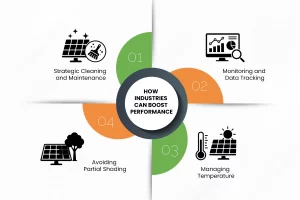
How Industries Can Boost Performance
You don’t need to be a scientist to improve the output of your solar plant. Most improvements come down to proper planning and consistent upkeep.
Strategic Cleaning and Maintenance
Dust, bird droppings, and industrial pollutants are the enemies of Solar Panel Efficiency. In a factory environment, air quality can often be lower, leading to faster buildup on panel surfaces.
Action: Schedule regular cleanings. Even a thin layer of dust can drop your generation by several percentage points.Pro-tip: Use soft, non-abrasive tools to avoid scratching the anti-reflective coating on your panels.
Monitoring and Data Tracking
You cannot manage what you do not measure. Modern solar plants should be equipped with real-time monitoring software.
Action: Use smart monitoring tools to track the performance of every string of panels. This helps you identify if a specific area is underperforming due to shading or a faulty connection. Early detection prevents minor issues from becoming major revenue losses.
Managing Temperature
Believe it or not, solar panels lose some of their effectiveness when they get too hot. This is a common challenge in the Indian climate.
Action: Ensure there is adequate space or “airflow gaps” between the roof and the panels. Proper ventilation helps dissipate heat, which helps maintain higher Solar Panel Efficiency even during the peak of summer.
Avoiding Partial Shading
Shading is a silent profit killer. If even a small portion of a panel is covered by a chimney, a water tank, or a neighboring building, the output of the entire string can drop significantly.
Action: During the design phase, ensure your solar plant layout avoids all possible shade. If shading is unavoidable, consider using “micro-inverters” or power optimizers that allow unshaded panels to continue working at full capacity.
Choosing the Right Technology
If you are planning a new installation or upgrading your existing plant, the technology you choose plays a massive role in your long-term success.
- Bifacial Panels: These capture sunlight from both the front and the back. By installing them on a high-reflectance roof, you can significantly increase your total energy yield.
- Half-Cut Cell Technology: These panels are designed to handle partial shade better than traditional designs. By splitting the panel into two, the system stays operational even if one half is shaded.
- Tier-1 Components: Always opt for high-quality, Tier-1 rated hardware. These components undergo rigorous testing and are built to withstand harsh conditions, ensuring that your Solar Panel Efficiency remains stable over decades.
Conclusion: Turning Sunlight into Profit
For the modern Indian industry, a solar power plant is more than just a green initiative—it is a strategic financial asset. By focusing on maintaining optimal Solar Panel Efficiency, you ensure that every ray of sunshine is converted into profit for your business.
With regular maintenance, smart monitoring, and the right technology, you can maximize your ROI and ensure your business stays powered by clean, cost-effective energy. Explore Novergy’s industrial solar solutions to get the most reliable, high-output technology available for your facility today.
Frequently Asked Questions
Q1: How much does dust impact solar efficiency?
Ans: In dusty industrial areas, output loss can range from 2% to 50% for conventional panels. Regular cleaning is essential to maintain peak performance.
Q2: Does heat affect solar panel performance?
Ans: Yes, overheating reduces efficiency. Proper installation with airflow gaps is crucial for maintaining high Solar Panel Efficiency in hot climates like India.
Q3: What is the benefit of Tier-1 solar components?
Ans: Tier-1 components are built for durability and long-term stability, ensuring your system performs reliably for its entire 25-year lifespan with minimal degradation.
Get product details