

Introduction: Storing Power When the Sun Sets
We are all moving towards energy here in India, but sometimes the sun does not shine when we need it to. The sun does not shine at midnight. When the grid is weak, your operations should not have to stop. That is where a BESS, also known as Battery Energy Storage System, comes in. Think of it as a power bank for your factory or office, like the one you use to charge your phone, but much bigger.
By storing power when you are producing too much and saving it for when you need it most, a BESS keeps your business running even when the local grid is not working properly. With India’s push towards renewable energy, it is good to know how these systems work from the beginning to the end.
What’s Actually Inside BESS?
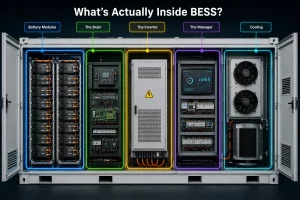
You might think a battery storage unit is one big battery, but it is actually a group of smart parts working together to keep the energy flowing:
- Battery Modules: These are the main parts. Small units packed with lithium-ion cells that hold the electricity, which is the power that a battery energy storage system needs to work.
- The Brain: The Battery Management System tracks heat and voltage to prevent any accidents, which is very important for a battery energy storage system.
- The Inverter: This hardware converts stored energy so your standard office equipment can use it efficiently, which is the purpose of a battery energy storage system.
- The Manager: This is the master coordinator that decides when to save power and when to release it, which is a part of a battery energy storage system.
- Cooling: technology like fans or liquid loops that keep the whole setup from getting too hot, which is important for a battery energy storage system.
People Also Read: BESS System For Solar
The Step-by-Step Guide to BESS Building Process
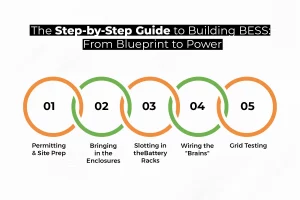
Building a battery energy storage system is not easy. It follows a clear pattern. Most of the time, they are grouped into “islands”. Self- units that connect to the main grid.
1. Permitting and Site Prep
It starts with paperwork for a battery energy storage system. Because these systems have a footprint and do not pollute the setup process is much easier than traditional power plants. Engineers verify the ground stability. Pour concrete foundations for a battery energy storage system. It’s like building a base for a high-tech shed, which is exactly what a battery energy storage system needs to stay safe and steady.
2. Bringing in the Enclosures
These are not containers; they are rugged weather-sealed steel boxes for a battery energy storage system. Once they arrive, cranes lock them onto the pads. These enclosures are important because they keep moisture, dust and heat away from the electronics inside a battery energy storage system.
3. Slotting in the Battery Racks
Technicians carefully slide modules into racks for a battery energy storage system. This design is a win for you because it’s scalable. If your business grows in three years you do not need a new system. You just add more modules to increase the total output of a battery energy storage system.
4. Wiring the “Brains”
This is the delicate part of building a battery energy storage system. The experts wire up the BMS, the EMS, and the PCS. They also install the transformer, which increases the voltage to match the high-voltage grid. They check every connection to ensure data flows smoothly between the batteries and the grid for a battery energy storage system.
5. Grid Testing
The last piece is connecting the system to the substation for a battery energy storage system. We install the switchgear and transformers, then run a series of stress tests. We check the software and safety sensors until we are 100% sure the power flow is smooth and the system is ready to operate, which is the step for a battery energy storage system.
BESS Checklist: Quality Control
- Tier-1 Cells: Are you getting cells or generic parts that might fail in a battery energy storage system?
- Smart Monitoring: Can you check the system status remotely from your phone for a battery energy storage system?
- Future-Proofing: Is the design flexible so you can add storage later for a battery energy storage system?
- Safety: Does the container meet your fire and safety codes for a battery energy storage system?
- Installer Experience: Have the people on-site done this before for a battery energy storage system?
Why Does This Process Matter?
A sloppy build is a problem. It leads to power leaks that drain your bank account. When you invest in a built battery energy storage system, you are not just buying hardware; you are paying for 15+ years of reliable energy.
Conclusion: BESS Building Process
Building a battery energy storage system is about precision engineering. It’s not a product; it’s a long-term plan to keep your power costs under control with a battery energy storage system. If you’re ready to start storing the power you generate, reach out to our experts.
Let’s talk about your site and a battery energy storage system.
FAQs: BESS Building Process
1. How many years of life can I expect from a battery energy storage system?
Ans: If you follow the maintenance schedule most modern systems give you a 10 to 15-year run.
2. Is a battery energy storage system safe to put at my business?
Ans: Definitely. Modern setups include fire suppression units and smart sensors that make them safe for use.
3. What is Open Access in BESS?
Ans: Open Access in BESS means storing extra solar power generated during the day and supplies it back when generation drops, like in the evening.
4. Does the BESS system need panels?
Ans: Not necessarily. You can also charge it from the grid during “off-peak” hours when electricity is cheap then use that power during the day when tariffs are high.
5. Is it hard to expand?
Ans: No. That’s the feature of the modular build. You can add more battery modules in the future as your requirements change for a battery energy storage system.
Get product details