Introduction: BESS in Open Access Solar
Run a factory, a shop, or anything that pulls serious power? You’ve probably heard people talking about open access solar by now. It’s one of the simplest ways Indian businesses cut power bills and go green without putting a single panel on their own roof.
Lately, though, there’s a new term floating around called BESS in open access. If you’re wondering what it means and why solar developers and factory owners alike keep bringing it up, you’re in the right place. Let’s break it down plainly.
What Is Open Access Solar?
In simple terms, Open access solar lets a business buy power straight from a solar plant, even one sitting hundreds of kilometres away. That power travels through the state’s existing grid and reaches your factory or office, same as your regular supply does.
Why Businesses Are Switching to It
The real draw is price. You end up paying far less than what your local electricity board charges, and depending on how open-access solar actually works for your load profile, that gap can mean lakhs saved every year.
What is Open Access in BESS?
BESS stands for Battery Energy Storage System; it’s basically a large battery setup that stores surplus electricity and releases it later when it’s needed. In open access, it stores extra solar power generated during the day and supplies it back when generation drops, like in the evening.
The Water Tank Analogy
Think of it like a water tank. Excess water gets stored when there’s surplus. When the taps run dry, or in this case, when the sun isn’t out, you draw on what you saved.
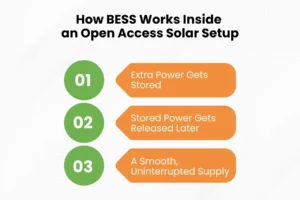
How BESS Works Inside an Open Access Solar Setup
Solar has one catch, though: it only works while the sun’s up. Come evening, or on a cloudy day, generation drops. But factories don’t run on sunlight schedules.
This is how BESS works in open access solar fills.
Step 1: Extra Power Gets Stored
During peak daylight, solar plants often generate more than a business needs right then. Instead of wasting that surplus, the battery system stores it.
Step 2: Stored Power Gets Released Later
After the sun sets or output drops, the battery releases what it saved. Your operations keep running on clean power well after sunset.
Step 3: A Smooth, Uninterrupted Supply
Smart controllers handle the storing and releasing quietly in the background, so operations don’t feel a thing. No sudden cuts, no scrambling for diesel backup.
Why Businesses Are Choosing BESS in Open Access Solar
This isn’t a niche trend anymore. Mercom India’s Q1 2026 market report puts open access solar additions at 2.7 GW for the quarter, up 170% from a year earlier, and battery storage is riding that same wave. Separately, the India Energy Storage Alliance reported that the country’s operational BESS capacity grew elevenfold in just the first half of 2026, crossing 8.5 GWh.
Here’s why businesses are jumping in:
- Power after sunset: battery backup stretches your green power access closer to 24×7
- Less reliance on the grid: every unit drawn from your battery is one you’re not buying at grid rates
- Steadier power flow: batteries smooth out dips and spikes that can trip sensitive machinery
- Lower diesel generator use: less backup dependency means real savings and less pollution
- Ahead of regulation: Rajasthan already requires BESS for certain captive open access solar setups above a load threshold, and more states are expected to follow
- Better returns on your solar plant: unused daytime power stops going to waste and actually gets used
Is BESS Right for Every Business?
Not everyone needs it on day one. It tends to make sense for:
- Factories running evening or night shifts
- Areas with frequent power cuts
- Businesses trying to cut diesel generator costs
- Companies chasing higher renewable energy targets for sustainability reporting
If your operations run purely in daylight and grid supply nearby is reliable, you can probably hold off. That said, battery costs keep falling, so more businesses are adding battery storage solutions in phases rather than waiting for a perfect moment.
Quick Checklist: Should You Add BESS to Your Open Access Setup?
- Do you run operations beyond daylight hours?
- Does your area see frequent grid outages?
- Are diesel generator costs eating into your margins?
- Do you have sustainability or renewable energy targets to hit?
- Is your state moving toward mandatory storage rules?
- Would smoother, more stable power protect sensitive equipment?
If you said yes to two or more of the above questions, then it’s worth exploring.
How Novergy Solar Can Help
At Novergy Solar, we design open access solar solutions that actually match a business’s load, budget, and location, not a one-size template. Whether you’re just starting out or looking to add storage to an existing setup, our team walks you through what makes sense without the jargon or the sales pressure, you can get in touch with our team directly for a straight answer.
If BESS in open access solar has you curious, explore Novergy’s open access and battery storage solutions and see what fits your business.
FAQs: BESS in Open Access Solar
1. What does BESS mean in open access solar?
Ans: Battery Energy Storage System. It stores extra solar power generated during the day and supplies it back when generation drops, like in the evening.
2. Does adding BESS increase costs?
Ans: There’s an upfront cost, but it’s usually offset over time through lower grid bills and reduced diesel generator use.
3. Can any business add BESS to its open access connection?
Ans: Most businesses with or planning an open access connection can add it, especially those running beyond daylight hours.
4. How long do battery systems usually last?
Ans: Most commercial and industrial battery systems run well over a decade with proper maintenance.
5. Is battery storage only useful for large industries?
Ans: No, large factories benefit most due to consumption size, but mid-sized businesses see real gains too with lower costs and steadier supply.
Get product details