Introduction: Captive Solar vs Open Access Solar
If your factory pays more than ₹8 per unit to the DISCOM, chances are someone has already pitched you both group captive solar and open access. Here’s the short version: open access gets you cheaper power sooner, and you don’t have to invest in ownership. Group captive also gets you cheaper power, plus a stake in the plant, and it skips two charges that quietly eat up 20-30% of what you’d save under open access.
Which one works better for you depends on how much power you use, how your state structures its charges, and how much money you’re okay locking up front. Let’s go through the differences one by one.
What is Open Access Solar?
Open access solar is for commercial or industrial buyer who purchases power directly from a solar plant, which could be sitting hundreds of kilometres away, and that power travels to you through the existing grid. You sign a power purchase agreement, the developer builds and owns the plant, and you pay a rate per unit plus the standard grid charges.
Since the Green Energy Open Access Rules came out in 2022, the minimum demand needed to qualify dropped from 1 MW down to 100 kW. That change opened this option up to a lot of mid-sized manufacturing units that previously couldn’t get in.
The main thing to understand: you don’t own any part of the plant. You’re simply buying solar energy.
People Also Read: How Does BESS Work in Open Access Solar?
What is Captive Solar?
In Group captive solar, a set of consumers come together and form a company (an SPV) that builds and owns the solar plant. Under the Electricity Rules of 2005, each member has to hold at least 26% of the equity in that company, and as a group, they need to use at least 51% of the power generated each year, roughly matching their ownership share.
That ownership requirement is really the whole point of the model. It’s what makes you a “captive user” in the eyes of the law rather than someone simply buying power from a third party, and that legal status is what gets you the bigger savings.
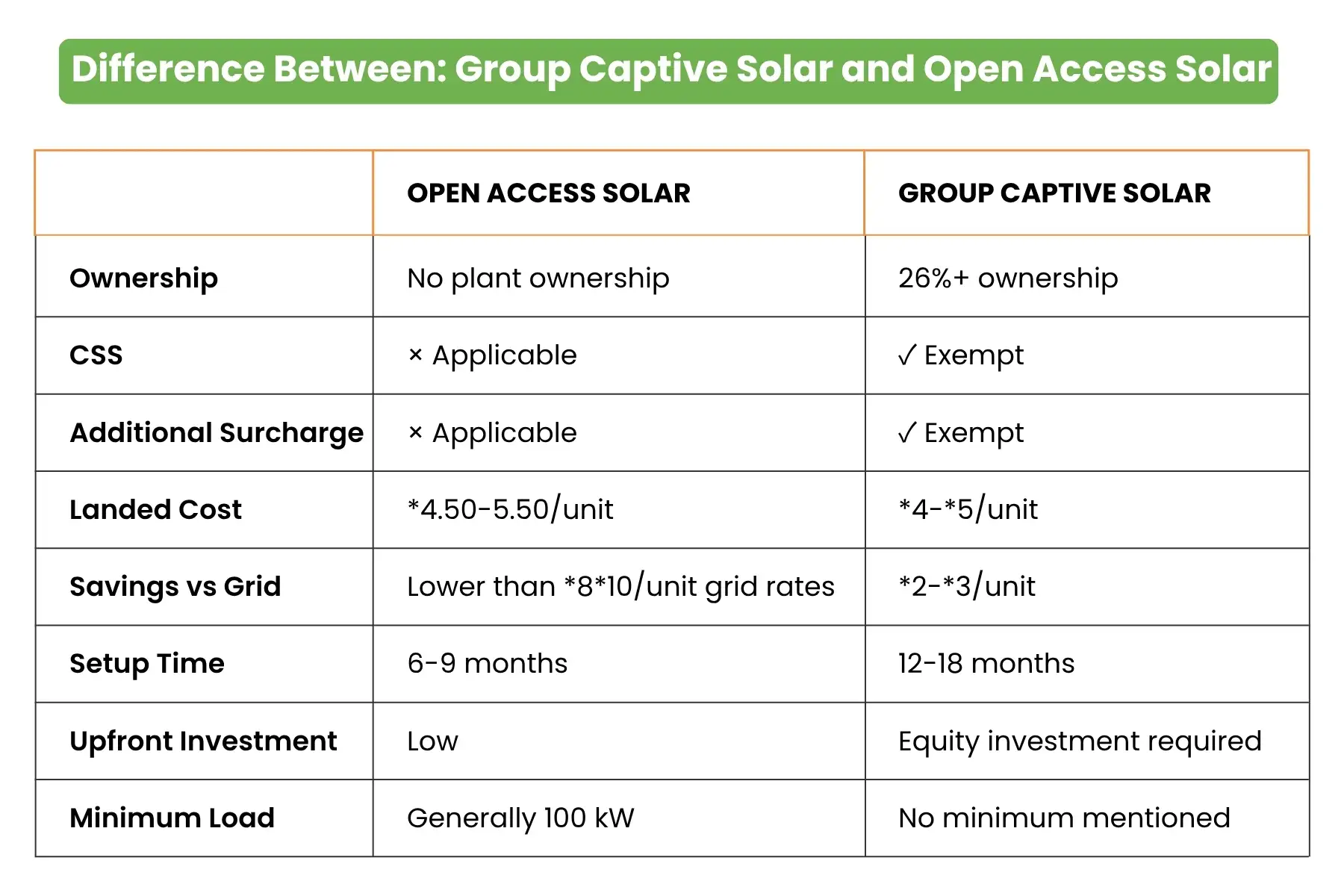
Difference Between: Captive Solar and Open Access Solar
Ownership
Open Access Solar: In open access solar, you own nothing. You’re a buyer under a contract that typically runs 15-25 years, with no money locked up and no responsibility for running or maintaining the plant.
Group Captive Solar: With a group captive, you own a piece of the plant itself, at least 26%, alongside the other companies in the same SPV. That means putting some money in upfront, but you also get a share of a long-term asset.
The Charges That Actually Change the Math
This is where the real difference shows up. Both setups involve paying wheeling charges, transmission charges, and banking charges. But there’s one difference that changes everything.
- Cross-Subsidy Surcharge (CSS): This hits open access buyers in full, but group captive consumers are exempt under the Electricity Act, 2003.
- Additional Surcharge (AS): Same story; captive and group captive users don’t pay it, open access users do.
- Put together, these two charges typically add ₹1.50 to ₹2.90 per unit onto what an open access buyer pays. The Supreme Court backed this exemption again in a 2021 ruling on how captive consumers should be classified.
In a state where CSS runs high, this one exemption can be the difference between a deal that actually saves you money and one that doesn’t.
What You Actually Save
Open Access Solar: Third-party open access usually lands power at ₹4.50-5.50 per unit once you add wheeling, CSS, and banking on top of a ₹2.50-3.75 PPA rate, compared to a DISCOM rate of ₹8-10 per unit.
Group Captive Solar: Group captive cuts out CSS and the additional surcharge entirely, which brings the landed cost down to roughly ₹4-5 per unit. That works out to about ₹2-3 per unit cheaper than grid power over the life of the project, and usually ₹1.50-2 per unit cheaper than a comparable open access deal.
How Long It Takes to Get Running
Open Access Solar: Open access moves faster. You sign the PPA, get your approvals from the state electricity regulator, and you’re usually up and running in 6-9 months.
Group Captive Solar: Group captive takes longer. Between finding the anchor member, setting up the company, raising the equity, awarding the EPC contract, and actually building the plant, the whole process usually takes 12-18 months.
Who Can Use Each Model
There’s no minimum load needed to be a group captive consumer. Open access is different; you generally need a contracted demand of at least 100 kW under the central rules, though a few states set that bar at 500 kW.
How This Plays Out in Rajasthan?
Rajasthan is worth looking at closely, since it’s now India’s largest solar state by installed capacity, sitting above 38.7 GW as of early 2026, with some of the best sunlight levels in the country.
Under RERC’s Green Energy Open Access Regulations from 2025, the eligibility bar here is also 100 kW. For someone signing a typical open access PPA in Rajasthan, the charges roughly break down like this:
- Transmission charges: around ₹170.79 per kW per month
- Cross-Subsidy Surcharge: around ₹1.58 per unit
- Additional Surcharge: around ₹0.72 per unit
- Banking charges: 8% deducted in kind
For group captive projects, Rajasthan’s RIPS 2024 policy goes even further, giving a full exemption from banking, wheeling, and transmission charges, on top of the usual CSS and AS exemptions. This makes the captive route especially attractive for textile and manufacturing clusters buying above 5 MW in the state.
That’s a genuinely different set of numbers compared to a plain open access PPA, and it’s why bigger industrial buyers in Rajasthan tend to move toward captive once their load crosses a few megawatts.
Before You Sign Anything
- Get your state’s actual CSS and Additional Surcharge numbers in writing, not rough figures from a sales deck.
- Work out your real cost per unit under both models using your last 12 months of actual usage.
- Check that your contracted demand actually meets the open access threshold in your state, which ranges from 100-500 kW depending on where you are.
- Ask any EPC company or developer for a timeline specific to your state, not a national average.
Final Thoughts: Captive Solar vs Open Access Solar
Pick open access if you want to move quickly and don’t want to put any money down. There’s no equity, no company to set up, no board to manage. You sign the contract, start saving, and that’s it. This suits businesses that want cheaper, cleaner power without touching their balance sheet.
Pick group captive if your load is large and steady, and you want to save as much as possible. If you’re using 3-5 MW or more, sit in a state with high CSS, or you’re comfortable locking into a 20+ year deal, the CSS and Additional Surcharge exemption alone usually makes the equity and the longer wait worth it.
Whether you choose open access solar or group captive solar, an expert solar provider is essential. Novergy Solar provides both open access and group captive solutions to businesses throughout India. Contact Novergy Solar today to get your own solar partner.
FAQs: Captive Solar vs Open Access Solar
1. Is group captive always cheaper than open access?
Ans: Not always. In states with lower CSS, like Karnataka, the gap shrinks. In states with high CSS, like Maharashtra or Rajasthan, group captive usually ends up meaningfully cheaper because of the surcharge exemptions.
2. Can a small factory use group captive solar?
Ans: Yes, there’s no minimum load needed for captive status, unlike open access, which needs at least 100 kW of contracted demand in most states.
3. How much money do I need to put into a group captive project?
Ans: At least 26% ownership in the SPV, with your share of the power roughly matching your ownership share, within a 10% margin under the current rules.
4. Does banking work the same way in both models?
Ans: The basic idea is the same, but the charges differ from state to state. Some states, like Rajasthan under RIPS 2024, waive banking charges entirely for qualifying captive projects.
5. Which model gets you up and running faster?
Ans: Open access, usually 6-9 months, compared to 12-18 months for a group captive company, since captive projects need members to sign on and equity to come in before construction can start.
Get product details