

Introduction: Understanding HJT Solar Panels
If you’ve been researching solar for your roof, you’ve probably run into a wall of PERC, TOPCon, mono, poly, bifacial, and now HJT Panels. It’s a lot to take in when all you actually want is lower electricity bills.
In this guide, we will cover what HJT solar panels are, how they work, why they’re considered one of the most advanced panel technologies right now, and whether they make sense for a rooftop in India.
What Does HJT Actually Mean?
HJT stands for Heterojunction Technology. While, a standard solar cell is basically one layer of silicon catching sunlight. HJT panels stack crystalline silicon with thin layers of amorphous silicon, similar to how any solar cell converts sunlight into usable electricity, except with an extra layer that does more of the work. That layering is the reason these panels perform better than others.
Every panel loses some sunlight along the way; a bit turns to heat, and some electrons escape before becoming power. HJT panels add a passivation layer that blocks a good chunk of that leakage. Less waste, more electricity, from the same sunlight hitting your roof.
How Efficient Are HJT Panels, Really?
Most standard panels sold in India convert somewhere around 19-22% of sunlight into electricity. HJT panels typically land at 23-25%, and premium imported models can push past that. If you want the fuller technical comparison, our TOPCon vs HJT breakdown covers the numbers side by side.
Why That Percentage Actually Matters
A few extra efficiency points don’t sound like much on paper. But it changes:
- How many panels you need to hit your target load
- How much rooftop space actually gets used
- Total electricity generated across 25 years
- How fast your system pays for itself
More efficiency means your roof works harder without needing to get bigger.
Why HJT Handles Indian Heat So Well
India gets hot, and heat isn’t gentle on solar panels. Every panel loses some output as temperatures climb; this gets measured through something called the temperature coefficient, or how much power drops for every degree above 25°C. HJT panels currently have one of the lowest temperature coefficients of any commercial panel technology, sitting around -0.24 to -0.26% per degree, compared to roughly -0.30 to -0.35% for older panel types.
That gap matters in states like Rajasthan and Gujarat, where rooftop surface temperatures regularly cross 60°C in peak summer. Older panels visibly struggle in that heat. HJT panels keep closer to their rated output.
Key Benefits of HJT Solar Panels
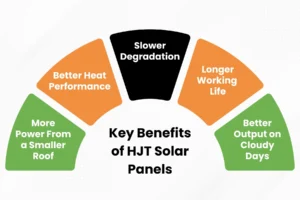
After really understanding what HJT panels are and how they work, here are some benefits of HJT solar panels:
More Power From a Smaller Roof
- Higher efficiency means fewer panels do the same job, which matters a lot if your rooftop space is tight.
Better Heat Performance
- HJT panels provide better heat performance than most of the other panels, with their lower temperature coefficient.
Slower Degradation
- Every panel loses a sliver of output each year. HJT panels degrade around 0.25-0.3% annually, noticeably slower than the 0.4-0.5% typical of older technologies. Over 25 years, that gap adds up to real extra electricity.
Longer Working Life
- Between the build quality and slower degradation, HJT panels are generally built to perform for 25-30 years, providing a genuinely long-term investment.
Better Output on Cloudy Days
- HJT tends to perform better in low light too, meaning steadier generation during overcast mornings or evenings, not just full sun.
Is HJT the Right Choice for You?
Here’s the honest part: HJT isn’t automatically the right pick for every roof.
These panels currently cost more than standard technologies, usually a premium of 15-40% depending on the brand and import source, based on MNRE’s ALMM listings, which still show limited domestic HJT manufacturing compared to TOPCon. So the real question isn’t whether HJT performs well or not, because it clearly does; the real question is whether the extra cost earns its keep on your specific roof.
Choose HJT if:
- Your rooftop space is limited
- Your electricity usage is high
- You’re in a very hot region
- You want the strongest long-term output, cost aside
A standard panel might suit you better if:
- Roof space isn’t a constraint
- You want the lowest upfront cost
- You’d rather stick with a widely available, ALMM-listed technology
Either way, get someone to actually look at your roof, location, and usage before deciding. A quick chat through our rooftop solar options is a reasonable place to start.
Where HJT Is Headed in India
Solar tech in India moves fast, and HJT is part of where it’s going. Domestic manufacturing is still catching up; Reliance Industries became the first company to get an HJT cell listed under MNRE’s ALMM in early 2026, which is a meaningful first step toward wider local production. As more Indian manufacturers enter this space, prices should ease over the next few years, making HJT less of a premium-only option.
At Novergy Solar, we’re tracking this shift closely and expanding our own work in advanced panel technologies, HJT included, so customers get access to what actually performs best, and not just what was popular five years back.
Quick Checklist Before Choosing HJT
Here is a checklist to make sure you are choosing the right panels:
- Confirm the temperature coefficient (look for -0.26%/°C or better)
- Ask for the real efficiency rating, not just the marketing number
- Check ALMM listing status if you need subsidy eligibility
- Compare the price premium against your expected long-term savings
- Get your roof’s shading and space constraints assessed first
- Ask about degradation rate and the performance warranty period
Conclusion: HJT Solar Panels
HJT panels are one of the more genuinely advanced options in solar right now, with their better efficiency, stronger heat handling, and a longer working life. They make the most sense on rooftops where space is tight, or summer heat regularly hurts older panel output.
That said, the best panel is the one that fits your roof, your budget, and your actual electricity needs, not the one with the highest spec sheet. If you’re weighing HJT against other options, explore Novergy Solar’s full range of panel technologies and get a recommendation suited to your specific setup. Contact Novergy today to get the best of your electricity bills.
FAQs: HJT Solar Panels
1. What is HJT in solar panels?
Ans: A Heterojunction Technology is a solar cell design that combines crystalline and amorphous silicon layers to improve efficiency and cut energy loss.
2. Are HJT panels better than regular ones?
Ans: Yes, on efficiency, heat resistance, and lifespan, but they cost more, though, so the right pick depends on your roof and budget.
3. Do HJT panels handle Indian summers well?
Ans: Yes, their low temperature coefficient means they lose less power in high heat than most other panel types.
4. How long do HJT panels last?
Ans: Typically 25-30 years, with slower yearly degradation than older panel technologies.
5. Is the extra cost worth it?
Ans: Usually yes if your roof space is limited or usage is high. For larger, unconstrained roofs, a standard panel may offer better value.
Get product details