Understanding the difference between AC and DC is important for solar energy. For photovoltaic technology to be used in our businesses, offices, and industrial areas it must be converted from direct (DC) to alternating current. Depending on the system and application, it may be better to use DC directly instead of converting to an AC source. This blog discusses the pros and cons of using AC solar panels between AC and DC and how solar AC systems compare to their DC counterparts.
Differentiate AC & DC Power
When it comes to solar electricity, it is important to understand the difference between alternating and direct currents. Photovoltaic technology works with direct current, which means that the power coming from the solar panel is pure direct current. However, this unregulated DC power supply cannot be used directly for utility applications. So an electronic circuit is needed to convert the current source into usable energy, whether direct or alternating.
The decision to use direct current or alternating current in photovoltaic systems is a challenging one. Both options may be better depending on the AC or DC system type and application. It is important to remember that the general power supply of our industries, offices, etc., runs on AC, and most of the appliances, electrical appliances, lights, fans, etc., in the market run on ac solar systems.
In a DC system, the system has the advantage of avoiding DC-AC conversion losses. It also reduces the cost of any inverter circuits or reverse technology. However, DC-based systems can only operate on lower standard DC voltages such as 6V, 12V, 2V, and 8V.
AC systems require an additional inverter circuit to convert direct current into a usable single or three-phase AC source.
Advantages and Disadvantages of AC and DC Solar Systems
AC Systems Advantages
- Each panel converts power independently, so shading or a fault on one panel doesn’t drag down the output of the rest of the array
- Easier to monitor performance panel-by-panel
- Simpler to expand incrementally, since each panel is self-contained
AC Systems Disadvantages
- Higher upfront cost per panel, since every panel needs its own microinverter
- More individual components on the roof, which can mean more maintenance points over the system’s lifetime
DC Systems Advantages
- Lower cost for large installations, since one or a few inverters serve the whole array
- Easier to service, since the inverter is typically ground-mounted or in an accessible location, not on the roof
- The standard choice for most commercial and industrial-scale installations in India
DC Systems Disadvantages
- If the array has partial shading or one panel underperforms, it can pull down the output of the whole string
- Less granular monitoring at the individual panel level
The two types of Solar AC power systems are
1. Battery-powered or hybrid solar energy systems
In battery-powered or hybrid solar energy systems, solar energy is converted into an AC source using an inverter. The inverter can also charge a battery bank as a data carrier. The battery bank can then be used as a power source when there is no sunlight or the solar panels are not producing enough energy.
These systems are particularly useful when the power grid is unreliable or unavailable, and a backup power source is required. They are also useful for industrialists who want to maximize their solar electricity consumption.
2. Grid and batteryless systems
Grid and batteryless solar systems convert all solar energy directly into AC and have no battery. These systems are connected to the grid, and the excess electricity produced by the solar panels is fed back into the grid. These systems are mainly used where the network supply is reliable, and the price of electricity is high.
On-grid and battery-free systems are also known as grid-tied systems and are the most common solar systems used in commercial applications.
LED lights, smaller fans, and similar products are usually available on DC power. Still, many common appliances such as air conditioners and refrigerators that require more power are not available on the market that are suitable for DC power. In systems that require the operation of such larger equipment, solar energy systems are not an option, and solar energy systems are necessary.
In DC systems, the rated current increases very quickly in the higher power classes due to the lower voltage. For example, a 10,000W solar power system running on a 12V DC bus has a rated output of 834 amps.
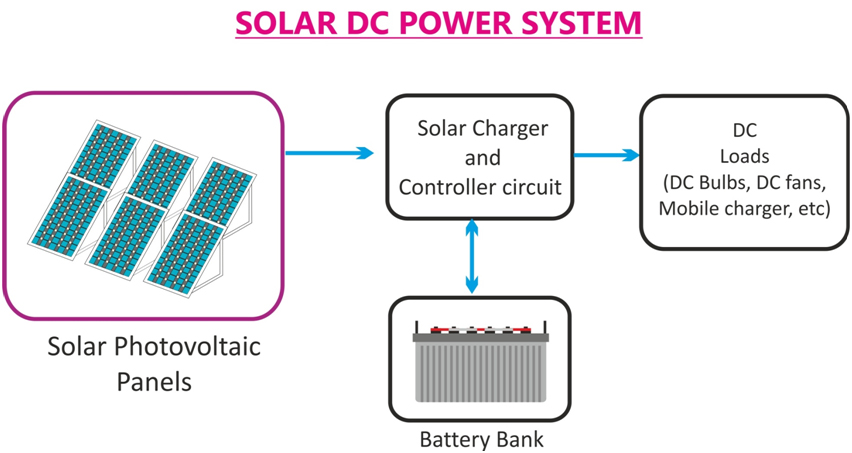
This increase in current ratings makes managing such a large current rating very difficult and expensive. It also adds cables, a switch, and other costs that may not outweigh the smaller benefits.
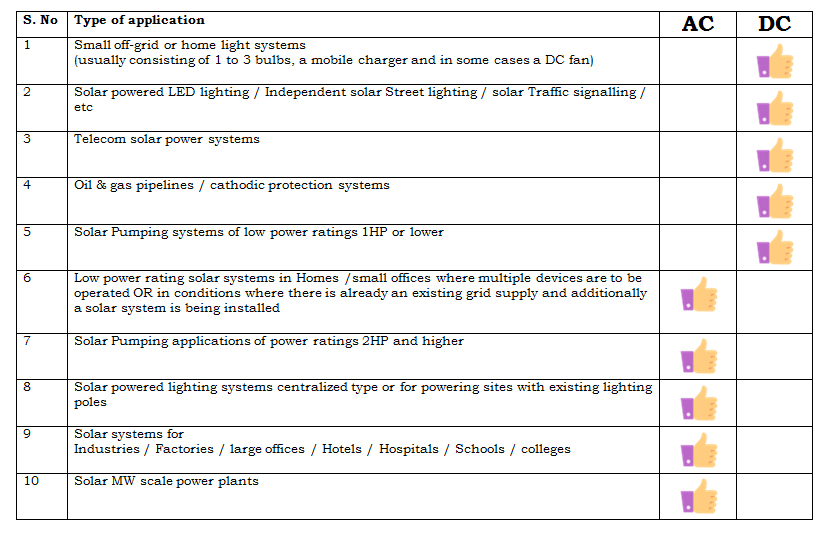
Also, DC cables are more expensive than AC cables of the same size. Therefore, as a rule, DC power systems can be suitable for lower power or applications where the power defaults to DC, such as LED lights, DC fans, telecommunications systems, cathodic protection systems, etc. Solar energy systems are more relevant, reliable, and cost-effective for higher power.
The choice between an AC or DC solar system depends on the application’s specific requirements. A solar power system is more suitable for low-power equipment and remote locations. Higher power needs and more complex applications require a solar energy system. Consulting with a qualified solar installer is always recommended to determine the best solar system for your specific needs.
Final Thoughts
Different scenarios require the use of either DC or AC in solar systems. DC systems are generally more reliable and efficient when using solar energy for basic electricity needs. However, for larger applications such as grid-tied systems, AC is the better option due to its higher power output and compatibility with other renewable energy sources. Ultimately, the best choice depends on the individual’s needs and preferences.
Below is the table provided, along with recommendations for the best solar inverter technologies:
Check out solar Panels: A Brief Guide on selecting the right one
Get product details