

Introduction: Your Large-Scale Power Bank
Think about the portable power bank you use for your phone. It saves your day when the battery hits zero.
Now, let’s understand it more simply. It is a very large device that can keep an entire factory or an office building running smoothly.
As of March 2026, India has reached a huge 283.46 GW of non-fossil fuel capacity, showing our commitment to a cleaner & better future. But renewable energy has one disadvantage: the sun doesn’t always shine, and the wind can be unpredictable. To make green power work 24/7, you need a reliable Battery Energy Storage System (BESS) to capture that energy and hold it until you actually need it.
What is a Battery Energy Storage System (BESS)?
A Battery Energy Storage System (BESS) is a smart technology that gets electricity from your solar panels or the grid and locks it in high-capacity rechargeable batteries. Think of it as a bridge between the moment power is created and the moment you flip the light switch.
When you pair your solar panel efficiency with a storage unit, you stop wasting the extra power you make at noon. Instead of feeding it back to the grid for pennies, your system soaks it up. This lets you run your business after dark without paying top-dollar rates to the main utility.
How Does a BESS Actually Work?
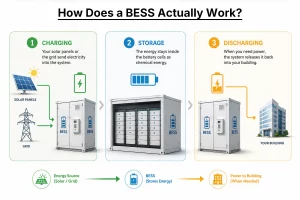
The working process of a BESS is very simple. It follows a three-step cycle that repeats daily:
- Charging: Your solar setup or the grid pushes electricity into the system.
- Storage: The juice gets tucked away in battery cells as chemical energy.
- Discharging: When the power grid falters or the sun drops, the system pushes that energy right back to your machines.
When you look at the on-grid vs. off-grid solar debate, it becomes clear that a BESS is a suitable option for keeping your operations stable during a blackout.
The Key Parts of a Battery Energy Storage System (BESS)
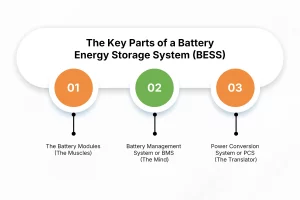
The system uses muscles and the mind to handle high voltages, so that it runs safely.
1. The Battery Modules (The Muscles)
This is where the electricity lives. Most high-end units use lithium-ion tech. By 2026, lithium battery costs have dropped drastically, making these high-capacity units a smart purchase for smart businesses.
2. Battery Management System or BMS (The Mind)
The BMS is your safety guard. It watches every single cell for heat or voltage spikes. If you choose the right solar developer, they will ensure your Battery Energy Storage System (BESS) has a top-tier BMS that prevents overheating before it happens.
3. Power Conversion System or PCS (The Translator)
Batteries speak “DC” (direct current), but your computers and machines speak “AC” (alternating current). The PCS translates the power instantly so your gear never knows the difference.
Benefits of BESS
Here are some benefits of BESS:
1. Cost Savings
BESS helps in saving energy at the time of low energy cost, so you can use the stored energy at the time of high energy demand at high prices. This also allows energy use to be moved to off-peak times when electricity is cheaper, further lowering costs.
2. Supports Peak Load Management
During grid failure or power outages, BESS helps to supply uninterrupted power for critical operations, minimizing downtime and preventing production losses.
3. Maximizes Solar Energy Utilization
Instead of sending excess solar power back to the grid, BESS stores it for later use. This increases self-consumption and improves the overall return on investment (ROI) of a solar power system.
4. Improves Grid Stability
Battery storage balances interruptions in power generation and consumption, ensuring a stable and reliable electricity supply for operations.
5. Lowers Carbon Emissions
Using more renewable energy helps lower carbon emissions, converting businesses to use more clean energy and less electricity generated from fossil fuels, helping achieve sustainability and ESG goals.
Why India Needs BESS in 2026
The government’s National Electricity Plan has aggressive goals for grid stability. For an Indian business, a Battery Energy Storage System (BESS) is no longer a luxury; it is a competitive advantage.
- Zero Power Cuts: You get a seamless backup that kicks in before your computers even blink.
- Peak Shaving: You charge up when power is cheap and use your own stash when grid prices skyrocket in the evening.
- Grid Stability: Large utility-scale projects now rely on these systems to keep the grid from crashing during extreme heatwaves.
Checklist: Is a BESS Right for You?
Use this quick list to see if your property is ready for a storage upgrade:
- Do you deal with daily voltage drops or power cuts?
- Are your evening electricity bills higher than your daytime costs?
- Do you have enough roof space to generate extra solar power?
- Is your goal to shrink your carbon footprint by 40% or more?
- Does your office use sensitive equipment that crashes during power blips?
Solar Energy and BESS: The Perfect Match
If you already have solar, adding storage is the only way to get a full return on your investment. Many factory owners prefer hybrid solar solutions because they combine grid reliability with total independence. Without storage, you often sell your “extra” power back to the grid for almost nothing. With a Battery Energy Storage System (BESS), you keep that energy for your own night shift.
Conclusion: Battery Energy Storage System (BESS)
The future of power is green, but the future of reliable power is storage. A Battery Energy Storage System (BESS) makes renewable energy work on your schedule, not the sun’s. Whether you want to stop losing money during power cuts or just want to slash your utility overhead, storage is the smartest play you can make this year. If you are ready to take full control of your power, explore Novergy’s energy storage range and find the right setup for your business today.
FAQs: Battery Energy Storage System (BESS)
1. Is a Battery Energy Storage System (BESS) safe for my factory?
Ans: Yes. Modern systems use a Battery Management System (BMS) that monitors every cell 24/7 to prevent fire risks.
2. How long does a BESS last?
Ans: Most Tier-1 systems are designed to last 10 to 15 years, depending on how often they get charged and discharged.
3. Can BESS help me save money?
Ans: Yes, by using stored power during “peak hours” when electricity is expensive, you can slash your monthly bills. Our commercial solar solutions help factories achieve this “peak shaving” daily.
4. What is the definition of BESS?
Ans: BESS (Battery Energy Storage System) is an advanced technology that captures energy from the grid or solar panels and stores it in rechargeable batteries.
5. Why do we need BESS?
Ans: We need BESS because, without storage, you often sell your excess power back to the grid at a low price. With a BESS, you keep that energy for yourself.
6. What is Open Access in BESS?
Ans: Battery Energy Storage System stores extra solar power generated during the day and supplies it back when generation drops, like in the evening.
Get product details