Introduction: TOPCon N-Type vs P-Type Solar Cells
Imagine a world powered entirely by the sun: clean, limitless, and sustainable. As we move closer to this vision, solar panels are playing a key role, using either N-type or P-type solar cells to capture energy. But with technology advancing and the demand for green energy soaring, one question remains: which type of solar panel truly leads the way?
N-type solar cells are made from N-type silicon, and P-type solar panels are made from P-type silicon. Both generate electricity when they are in reach of sunlight; however, there is still some difference between them.
N-type TOPCon cells generally beat P-type PERC cells on efficiency, heat tolerance and long-term degradation, which is why TOPCon has become the mainstream choice for new projects. P-type PERC remains a proven, widely installed option. The right choice depends on your roof space, climate and project timeline.
In this blog, we will dive into the depths of how TOPCon n-type and p-type solar cells work, their advantages and disadvantages, what is best for you, and answer some questions that might arise after learning about both these solar cells.
What is an N-type Solar Cell?
N-type Solar cells are photovoltaic devices that are made from materials such as monocrystalline silicon with additional doping of elements like phosphorus or arsenic, which makes them high in electrons, resulting in a surplus of negative charge carriers.
In an N-type cell, electrons are the majority charge carriers. These electrons can move freely through the material. When sunlight hits the cell, the photons energize the free electrons, causing them to flow toward the front surface and produce electricity.
Advantages of Using N-type Solar Cells
Both N-Type and P-Type Solar Cells have their advantages and disadvantages, and these are some advantages of the N-Type solar cells.
Modern Photovoltaic Technology: N-type solar panels can generate up to 25.7% more electricity than traditional solar panels.
Doping and Semiconductor Materials: N-type solar cells use materials such as monocrystalline silicon with additional doping of elements like phosphorus or arsenic, which makes it rich in electrons.
Layer Configuration in N-Type Cells: N-type Cells usually have a thin upper P-type layer and then a thick N-type layer as a base. This creates a p-n junction, leading to the absorption of sunlight and then the conversion to electricity.
Higher Carrier Lifetimes: N-type solar cells have a longer lifetime as compared to P-type cells.
Long-Term Stability in Outdoor Conditions: N-type solar cells have long-term stability in outdoor conditions as compared to P-type cells.
Lower Levelized Cost of Energy: N-type solar cells can potentially lead to a lower levelized cost of energy due to their higher efficiency and longer lifespan compared to P-type cells.
Increasing Usage in Utility-Scale Projects: On a larger scale, utility companies are turning to N-type silicon for renewable energy projects and photovoltaic systems due to its ability to generate more electricity per square meter of land.
Disadvantages of Using N-type Solar Cells
Higher upfront module price: N-type modules have typically carried a premium over PERC, although the gap has narrowed as TOPCon production has scaled. Compare current quotes.
Quality varies between makers: Cell quality and warranty terms differ between manufacturers, so ask for datasheets, LID/LeTID/PID test reports, and factory track record.
Supplier selection matters: Not every N-type module performs the same in the field, so compare degradation guarantees and certifications, not just the cell type.
Limited Availability Compared to P-Type: As the materials to make this are hard to find, their availability is limited.
Integration with Existing Systems: Integrating new or modified N-type systems into existing systems can be challenging due to the complexity of ensuring compatibility across different technologies, data formats, and architectures.
Specialized Maintenance Knowledge: The expertise required to maintain systems or equipment that specifically utilize or are based on n-type semiconductors is a very high level of maintenance knowledge that can only be learned by a few.
What are P-type solar cells?
P-type solar cells are made by doping silicon with boron. This doping creates “holes” in the material, enabling positive charge carriers to move easily when light is absorbed. It is a solar technology that is dominant in today’s solar market.
P-type cells have boron atoms added, resulting in a lack of electrons or “holes” in the atomic structure. The boron accepts electrons from the adjacent N-type layer, forming the PN junction where power is produced.
Advantages of P-type solar cells
Both N-Type and P-Type Solar Cells have their advantages and disadvantages. Here are some advantages of the P-type solar cells.
Material Composition and Simplicity: P-type semiconductors are created by doping intrinsic semiconductors like silicon or germanium with trivalent impurities such as boron or aluminum. These impurities act as acceptors, introducing “holes” which act as positive charge carriers and increase the material’s conductivity.
Compatibility with Existing Production Lines: As it is already getting widely used in the market, its compatibility is better than N-type.
Lower Initial Costs: P-type silicon wafers generally have a lower initial cost compared to N-type wafers. This is primarily due to the simpler production process and lower material costs involved in creating P-type wafers.
Dominance in the Current Market: P-type solar cells were announced earlier than N-type and are cheaper too, making them dominant in the current Solar market.
Optimized for Average Sunlight Conditions: P-type solar cells are made for the optimization of average sunlight conditions, which makes them usable.
Disadvantages of using P-type solar cells
Impact on Long-Term Performance: P-type semiconductor materials in solar cells can experience lower long-term performance compared to n-type because of light-induced degradation, potential-induced degradation, and lower efficiency rates.
Restrictions in Advanced Cell Architectures: P-Type cells generally have a lower theoretical efficiency ceiling compared to N-Type cells, making them less suitable for cutting-edge applications. They can be hard to integrate into advanced cell architectures.
Faster Performance Decline in Harsh Environments: P-type cells are usually suitable for average environments and can be low performers in harsh environments.
Energy-Intensive Production Processes: P-type cells, while having a lower investment in manufacturing, can get expensive as they are an energy-intensive production process.
Reduced Adaptability to Smart Grid Technologies: P-type has challenges that refer to the fact that smart grid features are not fully compatible or adaptable to certain grid types or components.
What Suits You the Best
Choose N-type TOPCon if roof or land area is limited, your site runs hot for much of the year, or you want lower degradation over a 25-year-plus asset life. P-type PERC can still suit projects with tight timelines or existing PERC-based designs. Whichever you choose, compare datasheets for efficiency, temperature coefficient, degradation guarantee, and warranty terms.
People Also Read: TOPCon Solar Cells vs Mono PERC Solar Cells
Conclusion: TOPCon N-Type vs P-Type Solar
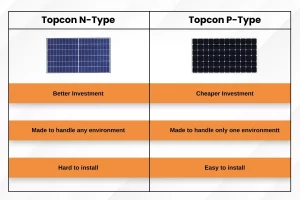
For industries and organizations aiming for sustainable energy, choosing the right solar cell is crucial. TOPCon N-type and P-type solar cells each have pros and cons. N-type cells, though more expensive, offer reliable performance in diverse climates—ideal for long-term use. In contrast, P-type cells are cheaper but work best in consistent, normal sunlight, making them less versatile for varied industrial needs.
Contact us today to learn more about our Topcon N-Type and P-Type Solar Cells.
FAQs: TOPCon N-Type vs P-Type Solar
1. What is the main difference between N-type TOPCon and P-type solar cells?
N-type solar cells are made using phosphorus-doped silicon, creating a surplus of electrons, while P-type cells use boron-doped silicon, resulting in “holes” as charge carriers.
2. What are N-type TOPCon cells?
N-type TOPCon (Tunnel Oxide Passivated Contact) cells are built on an N-type silicon wafer with an ultra-thin oxide layer and a doped polysilicon layer at the rear.
3. Can N-type solar panels perform well in harsh climates?
Yes, N-type solar cells are known for their long-term stability and superior performance in various environmental conditions, including high temperatures and low light.
4. What are the challenges associated with P-type solar cells?
P-type cells are prone to light-induced degradation (LID), have a lower efficiency ceiling, and can degrade faster in harsh environments compared to N-type cells.
5. Are N-type solar panels worth the higher investment?
While N-type panels have a higher upfront cost, their enhanced efficiency, durability, and longer lifespan can provide better long-term value, especially in large-scale and utility projects.
6. Is it possible to integrate both N-type and P-type solar panels in one system?
Technically, integrating both types may require specialized inverters and careful system design to ensure compatibility and efficiency.
7. Which type of solar cell is more commonly used worldwide?
N-type cells are more widely used for their advanced efficiency and performance.
8. Which type of solar cell do large industries and factories prefer?
Large industries and factories often prefer N-type solar cells due to their higher efficiency, durability, and reliable performance in various climates, despite the higher initial cost.
9. Are P-type solar cells commonly used in industrial applications?
While P-type solar cells are cost-effective and widely used in residential settings, many large industries lean towards N-type cells for their long-term efficiency and stability, especially in demanding environments.
Get product details